The "GGPoker hack" categories we keep getting asked about
By Raul Moriarty ·Poker Software Expert
Every time we onboard a new dev, the "GGPoker hack" question shows up in the first week. We break it into five categories and walk through them. Four are dead — architecturally, economically, or both. The fifth is the only one where any of us actually still make money.
Summary
- Server-side exploits against GGPoker are not feasible in any working form. Card data lives server-side under encrypted transmission; the client never sees opponent hole cards before showdown.
- RNG prediction is closed off by a CSPRNG seeded from multiple entropy sources with the deal committed before cards reach the client. iPoker 2013-style flaws do not apply to modern operator architecture.
- "Hole-card HUDs" do not exist on GGPoker. Historical superuser exploits on other networks (UltimateBet 2007, Absolute 2007) were operator-internal collusion, not external software.
- The only category with real engineering is decision-support AI: solver-anchored policies plus online opponent modelling, operating on visible game state.
- Most of what is sold as "GGPoker hacks," is either a repackaged bot with misleading and over-the-top sales copy, a site that steals your login credentials when you enter them to access the software, or remote-access malware.
The taxonomy of poker "hacks"
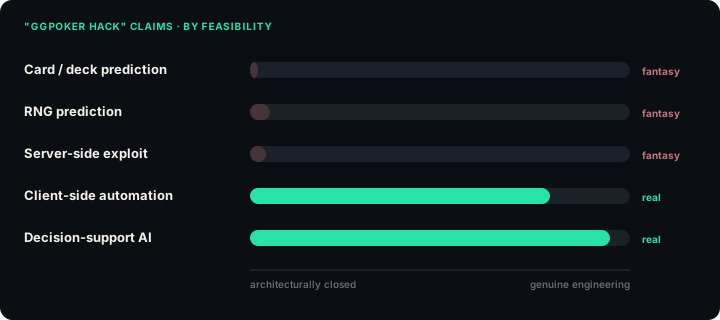
The first useful step is to stop treating "GGPoker hack" as a single thing. Looking at the search intent behind the phrase, there are at least five distinct categories hiding under one name. To have an honest technical conversation about any of them, they have to be pulled apart.
| Category | What it claims | Required capability | Feasibility |
|---|---|---|---|
| Server exploit | Read cards from operator DB | Remote code execution on operator infrastructure | Theoretically yes, practically no — value goes to bug-bounty or state actor, not a $99 download |
| RNG break | Predict next board card | Recover CSPRNG state from observed outputs | No — modern CSPRNGs are not invertible from card outputs at the rate poker exposes them |
| Hole-card peek | See opponent cards live | Operator-side privilege or client packet decryption | No on GG — card transmission is server-authoritative and encrypted |
| Data-mined HUD | Long-horizon opponent stats | Aggregated showdown hands joined by stable player ID | Largely closed at GG by anonymous tables and rotating names |
| AI decision engine | Better play given visible state | Solver outputs + opponent model + UI automation | Yes — the only category with real engineering behind it |
Four of the five are either architecturally closed or economically nonsensical for a public product. The fifth is where the genuine work happens, and is what most "hack" listings actually are once the marketing varnish comes off.
Why server-side exploits are infeasible
GGPoker’s operating system design (like every other large provider) uses an aggressive separation of responsibilities. The client is simply a layer used for display purposes. All of the authoritative game state resides on the operators’ servers, but this state is validated by the server. Card data is produced on the server side, encrypted using TLS and further wrapped in an additional encryption level at the application layer, then sent to the client. The client never sees card information it should not have access to at its current position within the game. This design decision allows for smaller, lighter weight clients (i.e., mobile clients), but at the same time reduces the amount of surface area available to a potential attacker.
The typical threat model that people think of — a research group finds a vulnerability, turns that into a downloadable $200 package to sell on Telegram — does not reflect the financial incentive for someone who can find a remote code execution in an operators' environment. To be able to execute remote code (in their own systems) could earn a person either $600K in a coordinated disclosure program or $1M+ on a black market; they would also face possible jail time depending on the law enforcement/jurisdiction. Those two monetary rewards paths do not go via a Telegram landing page with Crypto Checkout.
The same reasoning as for GGPoker, applied to all serious operators (PokerStars, partypoker, WPT Global etc.) has closed down this type of category. People remember the major historical exploits — those on UltimateBet and Absolute Poker during 2007–08 — but these were internal cheating schemes by operators exploiting their own management/administrative access. The generalised structural lesson is: If such large-scale cheating happens again, it will be from an insider within the operating company and cannot then be resold to retail consumers.
Why RNG prediction does not work
While the "predict the next board" claim has the most obvious theoretical basis for dismissal, it's still worthwhile to take this one down as well; it's been a while since we've seen the long tail of the shadow cast by the iPoker 2013 event. The iPoker 2013 problem arose from an implementation flaw in their shuffling algorithm which created statistically predictable (i.e., deterministic) patterns after some number of hands were shuffled. This was years ago and in a very different system, based upon a completely different threat model.
Modern shuffling is accomplished using a cryptographically secure pseudo-random number generator (CSPRNG), seeded by many different sources of randomness including; hardware random number generators (HRNGs), time-based randomness from user interactions, that are refreshed as needed. Shuffle calculations take place in real-time and are "locked-in" for all users prior to being sent any information regarding cards to the clients. To each client, the shuffled deck appears as an opaque series of randomly ordered numbers revealed to them over a period of time based on when they were handed their hand of cards. Given the speed at which players can infer information about their own hand of cards (in addition to other player's hands), there is essentially no opportunity for a hacker to reverse-engineer the state of the CSPRNG.
The main reason for this typical crypto-argument: even assuming that it would be possible to view an infinite, complete and perfect output from an arbitrary number of CSPRNGs at maximum bandwidth, there will always be a high computational barrier against recovering internal state due to the design. A poker hand represents a small amount of time, very low rate, and highly filtered version of that output, with only 52 different ways to represent each card, with many being hidden from one player or another. Even based on data-rate differences alone, the attack is closed.
CSPRNG output rate:         ~10⁹ bits/sec (theoretical)
Information exposed via poker:  ~50 bits/hand × ~300 hands/hour
                            ≈ 15,000 bits/hour ≈ 4 bits/sec
Attack ratio:                ~2.5 × 10⁸ : 1
You cannot reconstruct a key from a one-in-250-million-attenuated signal. iPoker 2013 was not a generic RNG flaw; it was an implementation bug in a specific shuffler. No equivalent bug has been demonstrated against a modern operator since.
Hole-card peeks and the UltimateBet precedent
People who search for "GGPoker hole card hack" are usually thinking of UltimateBet and Absolute Poker — the 2007–2008 cases where insiders saw opponent hole cards live and used them to grind massive winrates against unsuspecting players. Those cases are foundational for understanding why retail "hole-card hacks" do not exist on modern operators.
The UB exploit was not a hack in the security-research sense. It was a deliberately built administrative feature, used by privileged insiders, undetected because nobody outside the company could observe it directly. It was caught by external analysis of suspicious hand histories — Russ Hamilton's accounts at improbable winrates over long samples. The breakthrough was statistical (Pat Postle's hand-history analysis, then widely confirmed), not technical.
Two things changed afterwards. Operators removed administrative hole-card visibility from production systems. And — more importantly — the regulatory environment grew around online poker, with most major operators now licensed in jurisdictions where audit requirements close that internal surface. Modern operators including GGPoker undergo regular RNG and security audits by firms like iTech Labs or GLI, with attestations that are publicly available. The audit does not prove security; it proves that the audit happened. Combined with the legal exposure operators now carry under licences in Malta, Curaçao, the Isle of Man and the regulated UK and EU markets, the incentive to maintain a UB-style backdoor is far below the incentive to remove it.
So the parsimony test on the claim that this forum post offers a "hole card view" of GGPoker would be: could the NSUS Group possibly jeopardize their Malta license, a $100 million+ per year revenue stream, and put their top executives at risk of jail time --- simply to sell access to a telegram channel?
What actually works: decision-support AI
The area of real engineering — and the area that most of the GGPoker “hack” lists are really about — is decision support artificial intelligence. This is covered in much greater detail on the homepage. Briefly though:
- Solver-anchored baseline
- Strategies derived from CFR are computed and stored offline for the major decision points. Pluribus (Brown & Sandholm, 2019; arXiv:1905.10311 and the Science paper) was the first to reach superhuman level in 6-max No-Limit Hold'em. The next engineering problem is shrinking those strategies enough to query them within a real-time response budget.
- Online opponent model
- Fast Bayesian updates to opponent statistics based on each individual opponent’s behavior (VPIP, PFR, 3-betting, fold-to-cbet by board texture, river aggression) are simple enough; however, convergence of such information over time while using an anonymous table is the difficult problem — See the detection note for a reason as to why long-horizon HUD tracking is blocked at GG.
- Policy combiner
- Determines by how much to deviate from the baseline based on the current estimation of your opponent, and introduces behavioral noise that takes into account potential detection (timing variance for actions, random deviation below optimal levels at times, schedule shaping)
- UI automation layer
- The visual state of the input and action output channel. It reads from the rendered client (a screen scrape or an accessible tree on mobile) and sends out taps or clicks with behaviorally-shaped latencies. This is probably the most boring of all layers. And it's likely to be broken after every time the operator changes something in their user interface.
None of this is magic. It is software competing in a game, not breaking a game. The edge comes from playing visible state consistently and well over long sessions — exactly the place a focused human is weakest.
Talk to the team
Questions on solver compilation, opponent-model convergence, latency budgets, behaviourally-shaped action selection, or anything else in this piece. The chat is read by the Poker Bot AI team.
The economics of the scam category
Two questions undo most of these listings on their own. First: if a working server exploit existed and sold for $99, why would its owner sell copies at all rather than use it quietly to extract multi-million-dollar advantages? Second: if someone genuinely had a live hole-card peek, why broadcast it to thousands of strangers who cannot verify it, instead of using it discreetly with almost no risk of being caught?
The category survives because three independent drivers keep feeding it. Sellers profit even when the software does nothing — the install itself, or a small upfront payment, is the product. Losing players reach for a one-button fix instead of a study habit, which is exactly the magical thinking these listings sell into. And the cost of building a believable landing page has collapsed: LLM-generated copy, stock-photo testimonials, and Telegram automation let one operator run dozens of brand names at once.
The category does not need to convert well to make money. A 2% conversion on free traffic at a $150 average order value, with a decent share of customers adding upsells, funds the operation indefinitely — without ever delivering anything of value to the buyer.
Open research areas
The category that does contain real research:
- Compression of multiway solver outputs. Pluribus needed 12,400 CPU-core-hours offline; production compression to mobile inference budgets remains an active engineering area. MonkerSolver's approach (subgame solving with depth-limited search) is one direction; faster Bayesian abstractions are another.
- Online opponent-model convergence under anonymous identity rotation. The minimum sample for a useful exploitative deviation given no stable player ID. Empirical floor sits around 80–150 hands of joint observation. Population-conditioned priors might cut this by half.
- Detection-aware action selection. Treating the operator's classifier as a noisy adversary and shaping the output distribution to maximise EV under a budgeted detection probability. The adversarial-classification literature (Dalvi et al. 2004, Lowd & Meek 2005, the modern adversarial-ML lineage) gives the formal tools; the poker case is asymmetric in interesting ways because the cost matrix is non-symmetric (false-positives on the operator side are very expensive).
- LLM-augmented hand-history analysis. Frontier LLMs are bad at live poker decisions — they hallucinate ranges, misapply ICM, lack frequency intuition — but they are useful at post-hoc annotation: flagging exploit hypotheses worth solver-checking. The boundary between "useful annotation tool" and "useful in-the-loop player" is sharper than the field acknowledges.
If you have work in progress on one of these topics, the chat is the place to raise it. A future note will go deeper on opponent-model convergence under anonymous tables, and the detection architecture piece covers the same ground from the operator's side.